Our ESG
commitments
Our ESG
commitments

Environmental and societal dimensions are at the core of our development process
We design living places in a world facing rapid environmental and social change. Our ambition is simple: to develop projects that remain valuable, livable and resilient, today, and for the people who will experience them tomorrow.
Our approach has matured over years, shaped by project experience, clearer expectations from our stakeholders, and the growing role of European standards.
This journey has led us to structure a consistent ESG framework: the Happiness Performance Ecosystem, built around a process, a decision-body (Happiness Performance Circle or HPC), an internal shared method (Happiness Performance Dashboard or HPD, and appreciation levels -Good/Very Good/Exemplary-).
We do not claim perfection. We advance step by step, learning from each project and raising the bar where it is credible and meaningful.

An internal standard to clarify
ambition and measure progress
All projects target an internal ESG benchmark: Good, Very Good or Exemplary. Based on measurable criteria.
This is not an image exercise. It reflects real decisions and tangible contributions and offers a shared understanding of where a project stands, and a transparent way to track progress over time.



Our Happiness Performance Dashboard (HPD)
This tool translates our ESG approach into four components that structure the project from start to finish:
Site Quality Assessment
Assessment of the intrinsic qualities of the site: climate exposure, access, mobility, environmental sensitivities, and potential.
Alignment
Alignment with EU & internal criteria. Our HPD brings everything into one place: 1. EU Taxonomy technical criteria; 2. SFDR for relevant investment vehicles (e.g., Duodev 2); 3. Ten Duodev 3 commitments (our rising ambition on climate, circularity, water, mobility, nature, social impact, and resource efficiency).
Differentiation
Beyond alignment, we encourage teams to identify where the project can go further. Two priority pillars are selected from Environmental and/or Social & Wellbeing dimensions. Each ambition is assessed against the local market: standard, above-market, or innovative. This is how projects build competitive advantage and create better user experiences.
Governance
Strong governance rules apply to all projects: ethics and compliance, corporate behaviors, financial integrity, decision processes, and responsible project management. This ensures consistency across countries and credibility toward banks, investors, and partners.
"Our approach is pragmatic. It helps our teams define clear sustainability priorities within each project and translate ambition into concrete choices.
It combines differentiation levers with a shared governance framework, ensuring consistency and transparency across all countries and for our shareholders.”Muriel Hubert,
ESG Director
Thematic ambitions across E, S and G
Our ambitions are structured around transversal themes that guide design intentions and concrete decisions:
Environmental
What it means on the ground: the rain has somewhere to go, summers are cooler, materials age well, and the air feels cleaner on your walk home.
Discover the general information about the projects
Discover the general information about the projects
Biodiversity
Protecting natural areas, regenerating soils, and enhancing ecological value where feasible.
-
Terra Nostra (Braine-l’Alleud, BE)
At Terra Nostra, Equilis introduced an urban forest of 10,000 native trees using the Miyawaki method. Planted over 35 ares and composed of 27 local species, this dense forest accelerates natural growth, improves soil quality and strengthens local biodiversity. The planting was carried out with residents, schools and local stakeholders, making biodiversity a concrete, collective action embedded in the project.
-
La Canopée (Sophia Antipolis, FR)
- At La Canopée, biodiversity was addressed well before construction. Detailed fauna and flora surveys guided decisions on protection, relocation and transplantation, including measures to safeguard migratory birds. During earthworks, 100,000 m³ of soil was screened and reused to limit transport and disturbance. Beyond the site, Equilis partnered with the French National Forestry Office (ONF) to replant over 1,100 trees in the Alpes-Maritimes, directly contributing to local ecological restoration.
-
At La Canopée, over 70% of the 3.5-hectare site is dedicated to green and permeable spaces, forming a continuous ecological framework rather than residual landscaping. Existing wooded areas, olive trees and natural talwegs have been preserved, while new planted corridors ensure ecological continuity across the site. Specific measures (hibernacula, stone piles, adapted lighting) were implemented to protect identified species, including reptiles listed on regional red lists.
Water
Reducing potable water use, creating circular water cycles, and avoiding downstream impacts.

-
La Canopée (Sophia Antipolis, FR)
From the earliest design stages, La Canopée was planned around the presence of the Christine sinkhole (aven), a mapped natural geological feature on site. Part of the rainwater collected on the project is infiltrated and discharged into the aven to help restore natural underground water flows.
Existing swales and talwegs are preserved and used as natural rainwater management systems, allowing surface water dispersion in selected areas to limit erosion during heavy rainfall. Soil permeability tests and hydraulic studies were carried out to validate infiltration capacities and mitigate flood and erosion risks, ensuring a water management strategy aligned with the site’s natural topography.
-
Bellevue (Jambes, BE)
At Bellevue, water is treated as a shared resource and a structuring element of the neighbourhood. A new pond is created to support urban agriculture irrigation, while the entire water journey is deliberately made visible across the different parts of the district through swales, open basins, irrigation systems and a rainwater impluvium currently under study.
This “theatricalisation” of water makes its presence tangible in daily life and helps raise awareness among residents of its value and limited nature. Combined with rainwater reuse systems, these installations allow the neighbourhood to be hydraulically resilient for a 100-year return period (market practice: 25 years), with no discharge of rainwater into the public sewer network under normal conditions.
-
Greenius (Berlin, GER)
Above the heads of future users, the green retention roof works as a matter of course. It stores rainwater, releases it into the subsoil in a controlled manner and thus contributes to the sponge city and climate adaptation in urban areas. During heavier rainfall events, excess water is stored in underground cisterns or seeped away on the property via trenches.
In dry phases, the stored water can be used again for green roofs and irrigation of green spaces.
Save rain. Relieve the city.
Mobility
Reducing land take and emissions, supporting soft mobility, and improving accessibility for all.

-
Oder (Berlin, GER)
At ODER, mobility is addressed through a certified, built-in concept rather than compensatory measures. The project has achieved pre-certification GOLD from the Mobility Council, recognizing its low-car, multimodal strategy. A dedicated bicycle ramp provides direct and safe access from street level to a very large underground bike parking, enabling everyday use for all types of bicycles. Car parking is deliberately limited, while infrastructure prioritizes cycling and soft mobility as the primary modes of access, anchoring mobility choices directly in the building’s design.
-
Docks Bruxsel (Brussels, BE)
Equilis actively reshaped mobility rather than adapting to existing constraints. A new tram stop — “Docks Bruxsel” — was created specifically for the project, directly connecting the site to Brussels’ public transport network. This was complemented by redesigned pedestrian routes, dedicated cycling paths and 265 secure bicycle parking spaces, encouraging daily use of soft mobility.
-
La Canopée (Sophia Antipolis, FR)
Mobility at La Canopée is structured around a clear principle: keep cars underground, free the ground for people and nature. More than 760 parking spaces are fully buried, allowing surface areas to be entirely dedicated to pedestrians, landscaping and soft mobility. Direct pedestrian links connect the site to Sophia Antipolis’ bus hub, while secure bicycle parking, shared e-bikes and continuous walking paths make daily mobility possible without relying on the car.
Energy & Materials (via EU Alignment)
Life-cycle assessment (LCA), fossil-free heating, renewable energy production, circularity and waste reduction.

-
Nexum (Fuenlabrada, SP)
At Nexum Retail Park, energy production is extended beyond the site itself. The project hosts Spain’s largest solar energy community, with 1,350 photovoltaic panels installed on the rooftops, representing 735 kW of installed capacity and producing over 1 million kWh per year. This local renewable energy supplies the retail park and allows up to 1,100 nearby households, located within a 2 km radius, to access renewable electricity without individual installations. The electrical infrastructure is monitored in real time, enabling continuous optimisation of energy efficiency and supporting the project’s long-term decarbonisation strategy.
-
Greenius (Berlin, GER)
Greenius reduces its carbon footprint through clear structural and technical choices. The building combines a hybrid construction system, associating modular timber elements with concrete, optimising both embodied carbon and structural performance. A low-tech design approach further limits emissions, with decentralised ventilation systems, exposed timber ceilings and daylight-optimised layouts reducing material use and technical complexity. In addition, an innovative photovoltaic façade integrates high-performance solar panels directly into the envelope, contributing to on-site renewable energy production.
-
Docks Bruxsel (Brussels, BE)
At Docks Bruxsel, Equilis connected the entire shopping centre to the Bruxelles-Energie waste-to-energy incinerator, supplying the site with recovered heat for its heating needs. This system replaces conventional fossil-fuel boilers and allows the centre to operate without on-site combustion. As a result, Docks Bruxsel became the first large shopping centre in Europe to achieve carbon neutrality for its operational energy use, demonstrating how urban infrastructure can be leveraged to significantly reduce CO₂ emissions at district scale.
-
Silwana (Gorzow, POL)
At Silwana, Equilis anticipated future energy needs by designing the buildings to support photovoltaic installations across the entire roof surface. The structural capacity of the roofs was deliberately reinforced to accommodate large-scale solar panels when required, without additional construction works. This upfront investment allows the site to adapt over time to evolving energy strategies and regulatory requirements, embedding energy transition readiness directly into the project’s construction.
-
La Canopée (Sophia Antipolis, FR)
La Canopée combines low-carbon concrete for residential buildings with a timber superstructure for the office buildings, significantly reducing embodied carbon while ensuring structural efficiency. Extensive green roofs (up to 80 cm of substrate) improve thermal inertia, while photovoltaic panels and heat pumps allow the project to operate without gas, relying solely on electricity and on-site renewable energy production.
Social
What it means on the ground: you can get what you need within a short walk, the space feels welcoming at any hour, and neighbours have reasons to say hello.
Discover the general information about the projects
Discover the general information about the projects
Health & wellbeing
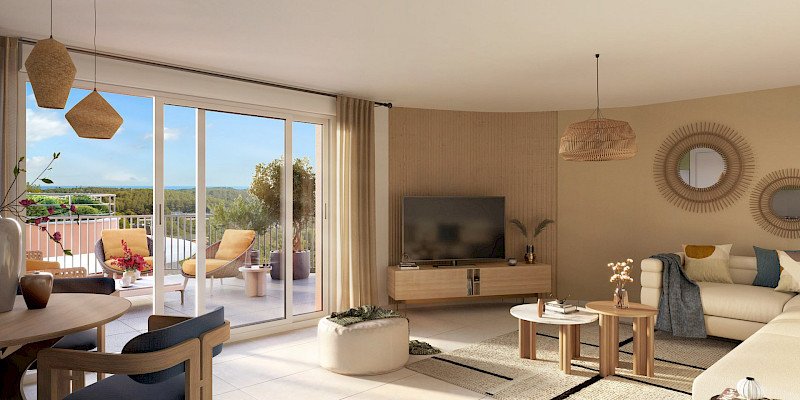
Air quality, natural light, thermal and acoustic comfort, qualitative indoor and outdoor spaces.
-
Court Village (Court-St-Etienne, BE)
From the earliest design stages of this former industrial site redevelopment, buildings were carefully oriented to maximise solar gain, improving natural light and passive heat contribution. As a result, 73% of façades are classified as “sunny” under the Quartiers durables criteria, translating rehabilitation choices directly into long-term thermal comfort and energy performance.
-
Les Papeteries de Genval (Rixensart, BE)
Well-being at Les Papeteries de Genval is rooted in the daylighting of a formerly buried river, which was uncovered and restored as part of the redevelopment. This watercourse now forms the structuring backbone of the site, shaping public spaces and pedestrian routes. A network of direct, walkable paths links homes, shops and public areas to the adjacent protected natural landscape, embedding nature, movement and calm into everyday life.
Social Cohesion
Context-driven aesthetics, heritage preservation, integrated cultural and educational spaces that strengthen community connection and human interaction.

-
Terra Nostra (Braine-l’Alleud, BE)
At Terra Nostra, the creation of a Miyawaki urban forest was conceived as a collective learning experience as much as an ecological one. Residents, schools and local actors were directly involved in the planting process, creating moments of exchange around nature, climate and shared responsibility. Beyond the trees themselves, the project fostered long-term awareness, intergenerational dialogue and a sense of ownership, anchoring the forest as a common place shaped by those who live around it.
-
Docks Bruxsel (Brussels, BE)
- At Docks Bruxsel, Equilis chose to make the site’s industrial history visible and accessible. The former Godin factory — the oldest industrial site in Brussels — was partially preserved and integrated into the project, including the restoration of the iconic “Cathedral” building. At its heart, the permanent Espace Godin exhibition documents the social and industrial legacy of Jean-Baptiste Godin, linking the site’s past to its contemporary urban use. By embedding heritage into everyday public spaces, the project reconnects visitors with the history of the place rather than erasing it.
-
Of the opening, Brussels-based artist Jean-Luc Moerman created a large-scale, site-specific artwork directly on the structural pillars and main lift core of the shopping district. Executed freehand and designed to interact with natural light through the glass roof, the work is accessible to all visitors in their daily journeys through the building. By commissioning a local artist and integrating art into the architecture itself, Docks Bruxsel makes cultural expression part of everyday urban use.
- At Docks Bruxsel, Equilis chose to make the site’s industrial history visible and accessible. The former Godin factory — the oldest industrial site in Brussels — was partially preserved and integrated into the project, including the restoration of the iconic “Cathedral” building. At its heart, the permanent Espace Godin exhibition documents the social and industrial legacy of Jean-Baptiste Godin, linking the site’s past to its contemporary urban use. By embedding heritage into everyday public spaces, the project reconnects visitors with the history of the place rather than erasing it.
-
Missiehuis (Driehuis, NL)
At Missiehuis in Driehuis, the historic former mission house is carefully repurposed into housing, preserving its architectural identity while adapting it to contemporary living standards. The project builds on the site’s cultural legacy and embeds it within a green residential setting, directly connected to the Kennemerduingebied and surrounded by existing local amenities, schools and sports facilities—allowing heritage to remain a lived, functional part of the neighbourhood rather than a static landmark.
-
V70 (Madrid, SP)
At Velázquez 70, a 1920s residential building in Madrid’s Salamanca district was carefully renovated to preserve its historic façade and urban presence while fully upgrading the interior to contemporary living standards. The project combines façade conservation with a discreet vertical extension, allowing the building to evolve without breaking the architectural continuity of the street. By adapting a protected structure to modern residential use, Equilis demonstrates how heritage buildings can remain active parts of the city rather than frozen artefacts.
Inclusion
Universal accessibility, functional mixity, intergenerational and social diversity.
-
Omega Valbonne (FR)
Omega Valbonne transforms a former hotel into a 104-unit social student residence, located within walking distance of SKEMA Business School and Mines Paris – PSL. The project delivers affordable housing in a highly constrained area, with fully accessible layouts, private outdoor spaces for every unit and shared facilities designed for everyday autonomy. By reusing the existing structure and working with public and social partners, Equilis responds to a concrete local housing need while supporting urban regeneration.
-
De Foyer (Hoofddorp, NL)
In Hoofddorp, outdated office buildings are replaced by 122 energy-efficient homes structured around a balanced housing mix: 50% private rental, 30% social housing and 20% middle-income housing. Part of the programme is specifically designed as care housing for seniors, ensuring accessibility and long-term adaptability. By combining different tenures and life stages within one redevelopment, the project responds concretely to local housing needs and supports social diversity within an existing urban fabric.
-
Docks Bruxsel (Brussels, BE)
At Docks Bruxsel, mixity is expressed through a diversified, on-site offer that goes beyond retail. Alongside the shopping destination with more than 100 units, the project integrates KOEZIO (indoor action/adventure), White Cinema, Espace Godin museum, a dedicated cultural/event space, as well as office space, creating a complementary active urban destination rather than a single-purpose retail scheme.
-
Les Papeteries de Genval (Rixensart, BE)
Les Papeteries de Genval illustrate functional mixity through the rehabilitation of a former industrial brownfield on a 7-hectare site, directly adjacent to a protected green area. After soil remediation and site cleanup, the former paper mills were transformed into a coherent urban district combining 390 homes, a senior residence with 101 apartments, and 15,000 sqm of retail and local services. This combination of housing, age-diverse living solutions and everyday amenities creates an active neighbourhood where residential life, services and landscape coexist within a single regenerated site.
-
Living Vredeoord (Eindhoven, NL)
At Living Vredeoord, the former Philips office building was converted into 166 mid-rental apartments, directly addressing Eindhoven’s strong demand for accessible housing. Located in the established Vredeoord residential area, the project reconnects a mono-functional business site with its surroundings, integrating housing into a neighbourhood already structured by public green spaces, local meeting places and everyday services, and within a 10-minute cycling distance from the city centre.
-
La Canopée (Sophia Antipolis, FR)
Located in the heart of Sophia Antipolis, historically dedicated almost exclusively to office uses, La Canopée introduces residential living for the first time at this scale. The project combines 212 homes (44% social housing) with 13,000 m² of offices and on-site services, creating a place that is active beyond office hours. By bringing housing, workspaces and shared amenities together, the project helps rebalance daily rhythms and transforms a mono-functional business park into a lived-in, mixed neighbourhood.
Governance
What it means behind the scenes: promises are written down, roles are clear, and independent voices challenge us.
Ethics & Compliance
Anti-corruption, AML, conflicts of interest, human rights safeguards.
Corporate Behaviours & Responsibilities
Clear delegation of authorities, transparent processes, integrity of information.
Financial Governance & Audit
Investment guidelines, accounting rules, internal and external auditing.
Responsible Project Management
Respect of the investment process, and the Happiness Performance process, quarterly reviews, documentation standards, ESG clauses with partners.